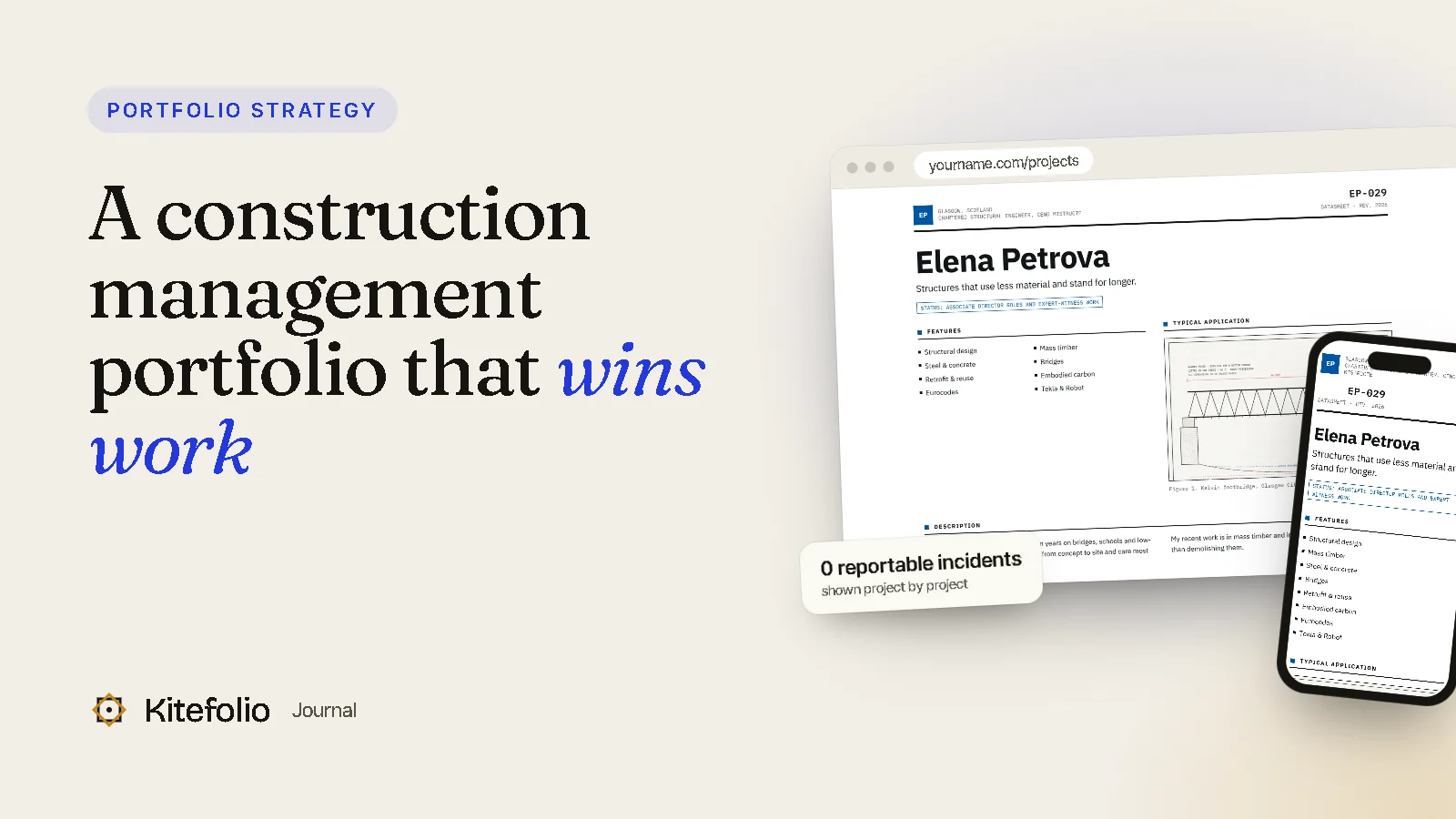
A construction portfolio, whether you are a construction manager or a contractor building your own firm, is a short, organised record of the projects you have run and the evidence behind them: what was built, the value and programme, your role, how you managed safety, cost and quality, and what the result was. A CV says you were a site manager on a £12 million school. A portfolio shows the phasing plan, the live-school constraints, the zero reportable incidents and the handover that happened two weeks early.
This guide covers what to include, how to write project case studies that hiring managers actually read, and how to turn it all into a simple online portfolio you can send with every application.
Why construction managers need a portfolio
Construction is a results business, and the people hiring you know it. A contracts manager, a client's project director or an agency recruiter wants to see three things quickly:
- Scale. What size and type of projects have you run? A £2 million fit-out and a £60 million mixed-use scheme need different managers.
- Delivery. Did your projects finish on programme, on budget and to quality, and when they didn't, what did you do about it?
- Safety. How did you run a site? Clients and principal contractors take this as seriously as cost.
A two-page CV can list the projects but rarely has room to prove any of this. A portfolio can, and because a website can be found on Google and shared as one link, it keeps working after your application is sent.
What to include in a construction or contractor portfolio
1. A short profile
Open with three or four sentences: your role (site manager, construction manager, project manager, contracts manager), the sectors you work in (residential, education, healthcare, commercial, infrastructure, fit-out), the typical project value you manage and where you are based. Add your availability, and if you work in the UAE or the Gulf, your visa status and notice period.
Avoid generic claims such as "results-driven leader". The projects below will do that work.
2. Three to six project case studies
This is the core of the portfolio. Pick projects that show range: different sectors, different contract types, a difficult site, a recovered programme. Three strong examples beat ten thin ones.
For each project, keep a consistent structure:
The project: what was built, where, the contract value, the procurement route (for example design and build, traditional or a JCT or NEC contract) and the programme length.
Your role: be precise. Did you lead the whole project, manage one phase, or run the site under a project manager? Hiring managers check references, and an honest scope reads as confidence.
The challenge: the constraint that made it hard. A live hospital or occupied school, a tight urban site with no laydown space, ground conditions, a late design change, a subcontractor failing mid-job, a peak summer programme in Dubai.
What you did: the decisions. Resequencing works, a revised logistics plan, a temporary works solution, a weekly look-ahead with trades, a change in procurement, a value engineering proposal.
The result: numbers wherever you can. Handed over on or ahead of programme, final account within a certain percentage of budget, defects at handover, RIDDOR-reportable incidents, client satisfaction scores, or a repeat appointment from the same client.
If a figure is confidential, give a range or a percentage rather than the exact value, and never publish anything your employer or client has asked you to keep private.
3. Photographs
Construction is visual, and photographs make your projects real. Include a few progress shots and a finished photo for each project. Make sure you are allowed to use them: check with your employer or client, avoid images that show people's faces without consent, and leave out anything that reveals security details of a site.
Before-and-after pairs work especially well for refurbishment and fit-out projects.
4. Safety record and approach
Give safety its own section rather than one line in your profile. Useful evidence includes:
- Your safety statistics across the projects you led, such as hours worked and RIDDOR-reportable incidents (in the UK, these are the injuries and dangerous occurrences that must be reported to the HSE)
- Specific initiatives you introduced: a permit-to-work system, a new induction, near-miss reporting, a mental health first aider on site
- Audits or awards, such as Considerate Constructors Scheme scores
Keep it factual. "Zero RIDDOR-reportable incidents over 410,000 hours worked" is far stronger than "excellent safety culture".
5. Credentials and training
List the qualifications and cards employers will look for, with dates. In the UK, these commonly include:
- A CSCS card. Managers usually hold the black Manager card, which is valid for five years and requires a recent CITB Managers and Professionals health, safety and environment test.
- SMSTS (Site Management Safety Training Scheme). The five-day CITB course for site managers, with a certificate valid for five years and a refresher course to keep it current. It is a separate requirement from your CSCS card, and many main contractors ask for both.
- NEBOSH certificates in construction health and safety.
- First aid at work.
- Professional membership, such as chartered membership of the Chartered Institute of Building (MCIOB) or RICS. The CIOB route to chartered status generally expects a degree-level qualification and several years of management experience, with alternative routes for experienced managers without a degree.
- Degrees and diplomas, such as an HNC, HND or degree in construction management, and project management qualifications such as PMP or PRINCE2.
In the UAE and the wider Gulf, add what local employers ask for, such as your degree attestation, any authority approvals you hold, and international qualifications like PMP, NEBOSH International or IOSH.
6. Software and methods
Name the tools you use day to day: programming software such as Primavera P6, Asta Powerproject or Microsoft Project, BIM and coordination tools, field apps for snagging and inspections, and your cost-reporting set-up. Mention methods too, such as lean construction, last planner, or earned value tracking, but only where you can point to a project where you used them.
7. References and testimonials
A short quote from a client's project manager, a contracts director or a design team lead adds weight. Ask permission before publishing a name, and keep each quote to one or two sentences about a specific project.
The numbers that make a case study persuasive
Construction managers are judged on a familiar set of measures. Where you have them, use them:
- Programme: handover date against contract date, weeks recovered after a delay
- Cost: final account against budget, savings from value engineering
- Safety: hours worked, RIDDOR-reportable incidents, audit scores
- Quality: defects at handover, snags closed within a set period
- Client: satisfaction scores, repeat work, references
- Team: size of workforce and number of trade packages managed
Use the figures you actually have. If you are still collecting them, write the case study with placeholders such as "handed over X weeks early" and fill them in before you publish. Never round a number up to make it look better: a client or reference can check it.
An example case study
Here is how a short case study might read on a portfolio page.
Primary school extension, Bristol · £4.2m · 48 weeks · JCT Design and Build
Role: Site manager, reporting to the project manager. Managed 14 trade packages and a peak workforce of 45.
Challenge: The school stayed open throughout, with 400 pupils on site and a single shared entrance.
What I did: Split the works into three phases around school holidays, moved deliveries outside drop-off and pick-up times, and set up a segregated pedestrian route with the head teacher.
Result: Handed over one week early with zero RIDDOR-reportable incidents across 96,000 hours worked, and the school asked us back for its next phase.
The figures above are illustrative. Yours should come from your own project records.
Turning your portfolio into a website
You can keep your portfolio as a PDF, but a simple website works harder. It can be found by recruiters searching for a construction manager in your area, it is one link to share on LinkedIn and in applications, and you can add each new project as it completes.
The construction manager portfolio template on Kitefolio is laid out for exactly this: a profile, project case studies with photos, safety and credentials sections, and contact details. You can start from your existing CV: upload it, and the template is filled with your roles and experience, ready to edit. Our guide on turning your CV into a portfolio website walks through the steps.
If your work spans wider project leadership, the project manager portfolio template is a good alternative.
How to build a construction portfolio in five steps
- Pick three to six projects that show the range of work you want more of: a fit-out, a new build, a refurbishment.
- Gather the evidence for each: value, programme, your role, the hardest constraint and the result, with photos from start to handover.
- Write one short case study per project: the brief, what you did, and the numbers (on time, on budget, incidents, defects).
- Add the proof clients check first: safety record, licences and memberships, insurance and two or three references.
- Put it online at your own address so you can send one link instead of a PDF, and keep it up to date after every job.
Frequently asked questions
How many projects should a construction management portfolio include?
Three to six. Choose projects that show range in sector, size and challenge, and put your strongest and most recent first.
Can I include projects where I was not the lead?
Yes, as long as you state your role accurately. "Assistant site manager on a £30m hospital scheme" is a strong entry when it is true.
What if my project information is confidential?
Leave out the client name, use a description such as "a 200-bed hotel in Dubai Marina", and give values as ranges. When in doubt, ask your employer or the client.
Do I need a portfolio for site manager jobs, or only for senior roles?
Both. A portfolio helps an experienced site manager stand out for a construction manager post, and it helps a newer manager show the projects behind their CV.
Should my portfolio show safety statistics?
Yes. Safety performance is one of the first things clients and principal contractors ask about. Report real figures for the projects you managed and explain what you did to achieve them.
How do I make a construction portfolio?
Choose your best three to six projects, write a short case study for each (brief, your role, constraints, results in numbers), add photos, your safety record and credentials, and publish it as a simple website you can share with one link.
What should a contractor's portfolio include?
A one-paragraph profile, completed projects with photos and values, the trades or services you offer, licences and insurance, a safety record, references or reviews, and clear contact details. Clients want to see work like theirs, finished well.