
Updated 4 November 2026
A construction company profile in the UAE is a short document, or better a website, that proves to a client, consultant or main contractor that you are licensed, classified, staffed and experienced enough for their project. The ones that win work lead with registrations and finished projects, not slogans.
This guide is for contractors, fit-out firms and MEP subcontractors in Dubai, Abu Dhabi and Sharjah who are asked for “your company profile” before every tender or pre-qualification. It covers what to include, what changes in 2026, and how to turn the PDF into something people can find on Google.
What is a construction company profile?
It is the evidence pack a client reads before they shortlist you. In the UAE it usually travels as a PDF attached to a pre-qualification questionnaire, a vendor registration or an email to a consultant. More and more, the same content also lives on a website, because procurement teams search for you before they open the attachment.
A good profile answers four questions fast:
- Are you allowed to do this work, at this value, in this emirate?
- Have you done similar work before, for clients they recognise?
- Do you have the people, equipment and systems to deliver it safely?
- Are you financially stable enough to finish?
Everything else is decoration.
What changes for Dubai contractors in 2026?
Dubai Law No. 7 of 2025 brings every contractor into one registration system, so your profile should show that registration clearly. The law took effect in January 2026, and existing contractors have a year to bring their registration into line, according to Mayer Brown’s summary of the law.
The points that matter for your profile:
- You can only take work inside your registration and classification. Contractors are grouped by experience and by financial, technical and administrative capability, and the classification limits what you can bid for.
- Minimum qualified staff. The law requires a minimum number of certified technical staff, so a clear team section is no longer optional.
- Subcontractors and partners must be registered too. Main contractors will ask for your registration before they add you to a joint venture or subcontract list.
- Annual renewal. Put the registration number and its renewal date on your profile and keep it current.
- Penalties are real. Fines go up to AED 100,000, and AED 200,000 for repeat offences, with suspension or downgrading possible (Fenwick Elliott’s review covers the detail).
We are not lawyers, and the implementing rules are still settling. Check your own position with Dubai Municipality or your legal adviser before you state anything about classification in writing.
What should a UAE construction company profile include?
Lead with proof of licence and classification, then projects, then people. Here is the order that works for most pre-qualification readers.
| Section | What to put in it | Why the reader cares |
|---|---|---|
| Company summary | Trade name, year founded, emirates you work in, one line on what you build | Tells them in ten seconds whether to keep reading |
| Licences and registration | Trade licence number and activities, contractor registration, classification, renewal dates | Decides whether you are even eligible |
| Authority approvals | Only the ones you actually hold, for example DEWA, Dubai Civil Defence or ADDC contractor approvals | Saves the consultant a phone call |
| Certifications | ISO 9001 (quality), ISO 14001 (environment), ISO 45001 (health and safety), with certificate numbers and expiry dates | Many tenders score these directly |
| ICV certificate | Your current In-Country Value score and expiry date | Counts in federal and many semi-government tenders |
| Completed projects | Project name, client, consultant, value band, your scope, dates, two or three photos | The most read section, by far |
| Ongoing projects | Same fields, with percentage complete | Shows current capacity and workload |
| Key people | Names, roles, qualifications and years of experience for the project manager, engineers and HSE lead | Required by the 2026 rules and by most PQQs |
| Equipment | Owned plant and vehicles, with quantities | Shows you will not depend on hire for everything |
| HSE record | Lost-time injury figures if you track them, HSE policy, training | A weak or missing answer here sinks bids |
| Financial standing | Bank reference, audited accounts available on request, turnover band | Shows you can carry the project |
| Contacts | One named person, phone, email, office address | Make it easy to send you the tender |
Keep it honest. If you do not hold an approval, leave it out. Consultants check.
Why does the ICV certificate matter so much?
Without an In-Country Value certificate you can still bid, but your ICV score counts as zero. The National ICV Programme is run under the Ministry of Industry and Advanced Technology, and the certificate is issued from your previous year’s audited financial statements, as Deloitte’s ICV guide explains.
In a close tender, a zero ICV score can be the difference between first and third. Put your score and expiry date on the profile’s first page, next to your classification.
How should you show projects?
Show fewer projects, with more detail. Ten well-documented projects beat a list of eighty names.
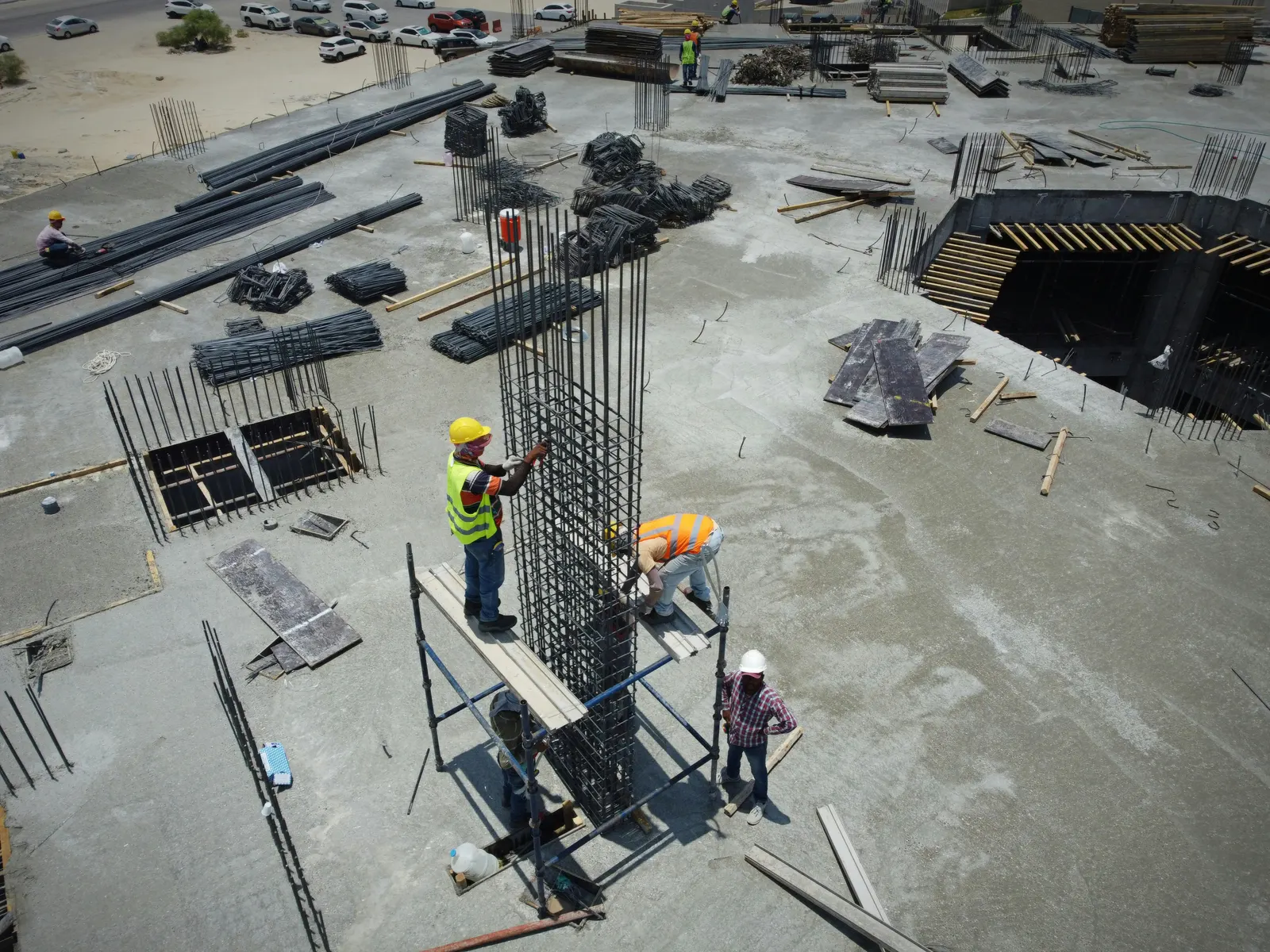
This is the kind of photo that wins trust: a real site, real work, taken from above in daylight. Photo: Glenov Brankovic on Unsplash.
For each one:
- Name and location. “G+12 residential tower, Jumeirah Village Circle” tells the reader more than a brand name.
- Client and consultant. Ask permission before naming a private client. Government and well-known developers are usually fine, but check.
- Your scope. Main contractor, civil works, MEP, fit-out, façade. Be exact.
- Value band. Many firms prefer a band (for example AED 10–25 million) to an exact figure.
- Dates. Start and handover. A project finished on time is worth saying so.
- Photos. Two or three of your own site photos, taken in daylight, with people’s faces avoided or blurred. Real site photos beat polished renders, because they prove you were there.
- One sentence on what went well. A tight programme, a live hospital you worked round, a value-engineering saving. Facts, not adjectives.
Group projects by type (residential, commercial, industrial, infrastructure, fit-out) so a reader looking for a warehouse finds warehouses.
PDF or website: which do clients actually read?
Both, at different moments. The PDF goes into the tender file; the website is what they look at first, usually on a phone.
| PDF profile | Profile website | |
|---|---|---|
| Found on Google | No | Yes, if it has its own pages |
| Easy to update | Re-export and re-send every time | Change one line and it is live |
| Readable on a phone | Pinching and zooming | Made for it |
| Attached to tenders | Yes, still expected | Send the link alongside |
| Shows photos well | Often compressed | Full size, fast |
| Shows you are current | Hard to tell how old it is | Dated updates, recent projects |
The best setup is a website that holds everything, with a button to download the PDF version. You update the site, then export the PDF when a tender asks for one.
How do you make the profile show up on Google in the UAE?
Give each part its own page and use the words clients type. Procurement teams and developers search phrases like “fit-out contractor Dubai”, “MEP contractor Abu Dhabi” or “construction company portfolio”.
A few things help:
- One page per service and one per major project. A page called “Warehouse projects in Dubai Industrial City” can be found; a single long PDF cannot.
- Your emirate and area in headings. Write “Dubai”, “Abu Dhabi” and the area names you actually work in.
- Real numbers you can stand behind. Floor areas, storeys, durations. No invented figures.
- A Google Business Profile with the same name, address and phone number as your site.
- Fresh updates. Add each finished project within a month of handover. Search engines and AI assistants both favour pages that are kept current.
Common mistakes in UAE company profiles
These are the ones we see most:
- Expired certificates left on page two. Check every date before you send.
- Stock photos of cranes and skylines. Readers spot them, and it makes them doubt the real projects.
- Claiming approvals you do not hold, or that belong to a sister company. It is easy to check and it ends the conversation.
- No named contact. “info@” with no person behind it slows everything down.
- Forty pages of history before a single project. Put projects in the first third.
- A 30 MB PDF that bounces off tender portals. Keep it under 10 MB, or send a link.
A simple checklist before you send it
| Check | Done? |
|---|---|
| Trade licence and registration numbers correct and in date | |
| Classification stated exactly as issued | |
| ISO and ICV certificates in date, with numbers | |
| Only approvals you actually hold | |
| At least five completed projects with client, scope, dates and own photos | |
| Named key people with roles and qualifications | |
| HSE section present | |
| One named contact with phone and email | |
| File size under 10 MB, or a link to the website | |
| Website link on the cover page |
Putting it online without a web agency
If you want the website version without paying an agency, start from a design made for the trade. Kitefolio has templates for construction managers and civil engineers that already have sections for projects, team, certifications and contact. You fill them in by clicking on the text, add your own site photos, and publish on your own domain. Have a look in the gallery, or read our guide to a construction management portfolio if you are building a personal one rather than a company one.
When you are ready, start free and put your profile online in an afternoon.
Frequently asked questions
What is the difference between a company profile and a portfolio?
A company profile proves you are eligible and capable: licences, classification, people and finances. A portfolio shows the work itself. In the UAE construction market clients expect both in one document, with projects as the biggest section.
How long should a construction company profile be?
Most effective profiles run 12–25 pages. Long enough to cover licences, projects, people and HSE, short enough to stay under the 10 MB many tender portals accept.
Do I need to register under Dubai Law No. 7 of 2025?
If you carry out contracting work in Dubai, the law brings you into a unified contractor registration system that took effect in January 2026, with a year for existing contractors to comply. Airport-related work is exempt. Check your own case with Dubai Municipality or a lawyer.
Can I bid without an ICV certificate?
Yes, but your ICV score counts as zero, which can cost you in tenders that weigh it. The certificate is based on your previous year’s audited accounts, so plan for it early in the year.
Should I put project values in my profile?
Use value bands rather than exact figures unless the client has agreed. Bands still show your capacity, and they respect your clients’ confidentiality.
Do you run a construction or fit-out firm in the UAE? We welcome guest posts on the Kitefolio blog: tell us what you have learnt about winning tenders here.